Falling AI Costs Could Accelerate Corporate Adoption, ARK Invest Says
ARK Invest estimates AI inference costs are falling 99% annually, while most businesses spend relatively little on advanced AI models. The widening gap between early adopters and other companies highlights the potential for broader adoption and productivity gains.


Declining AI Costs Put Corporate Adoption in Focus
Artificial intelligence is becoming significantly less expensive to operate, potentially changing how businesses integrate the technology into everyday operations. According to ARK Invest, AI inference costs are declining approximately 99% annually for a fixed level of performance, making increasingly sophisticated capabilities more accessible.
Despite these improvements, corporate adoption remains uneven. New spending data highlighted by ARK shows a substantial gap between businesses investing aggressively in AI and the majority that have committed relatively little. The findings shift attention from the cost of building AI infrastructure to the economics of using artificial intelligence across the broader economy.
Key Points
- AI is becoming cheaper to operate: ARK Invest estimates that inference costs for a fixed level of performance are declining approximately 99% annually, potentially improving the economics of business applications.
- Corporate adoption remains uneven: The most aggressive AI adopters spend nearly $10,000 per employee each month, compared with approximately $15 among the majority of businesses in the data highlighted by ARK.
- Productivity is the next question: ARK expects declining AI costs and broader business adoption to support efficiency gains, with potential implications for corporate expenses and inflation.
Falling AI Inference Costs Change the Economics of Business Adoption
One of the most significant developments in artificial intelligence is the rapidly declining cost of using AI models. ARK Invest estimates that inference costs are falling approximately 99% annually for a fixed level of performance. Inference refers to the computing required when an AI system responds to a question, generates content, analyzes information or completes a task. Unlike model training, which involves developing an AI system, inference represents the ongoing expense of putting that technology to work.
The distinction matters for businesses evaluating AI investments. As operating costs decline, companies can use less expensive models for routine activities while reserving more advanced systems for complex assignments. ARK argues that this flexibility could make AI applications economically practical across a wider range of business functions. Competition among model developers is also influencing the market. OpenAI, Anthropic and Alphabet (GOOGL), through its Gemini models, are among the companies developing increasingly capable AI systems, giving businesses different options when balancing performance requirements against operating expenses.
For companies already experimenting with artificial intelligence, declining costs can improve the financial case for expanding existing applications. For businesses that have delayed adoption, lower expenses may reduce one of the barriers to implementation. However, cheaper computing does not automatically produce higher profitability. Companies still need to identify useful applications, integrate AI into existing workflows and demonstrate measurable results. The significance of falling inference costs therefore lies not only in technological progress, but in how those savings could influence business decisions.
Why Have Most Businesses Barely Begun Spending on AI?
Corporate spending data highlighted by ARK Invest reveals a striking difference between early AI adopters and the broader business population. According to data from financial technology company Ramp, the top 1% of corporate AI adopters spend nearly $10,000 per employee each month on frontier AI models. Spending among the top 10% falls to slightly more than $800 per employee. For the remaining businesses, the figure is approximately $15.
Monthly frontier AI spending per employee
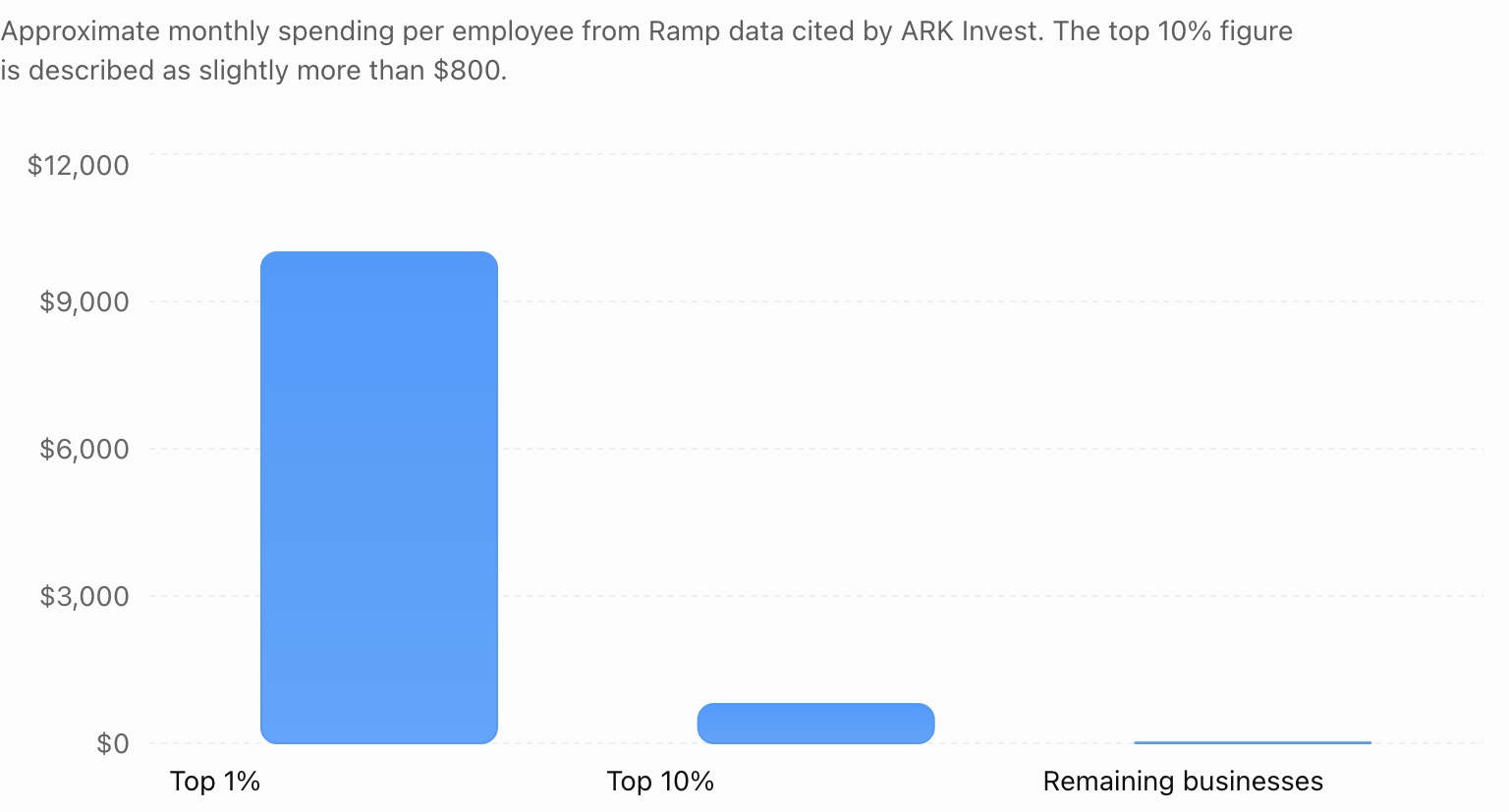
The differences suggest that AI adoption is far from uniform. Some companies are committing substantial resources to advanced models, while many others are spending comparatively little. ARK interprets this gap as evidence that enterprise adoption remains at an early stage, even as AI capabilities continue improving. The firm's argument is that businesses demonstrating successful applications could create competitive pressure for others to adopt similar technologies, as companies increasingly evaluate whether AI can reduce administrative work, accelerate analysis, improve customer interactions or support other business processes.
The pace of adoption will depend on more than model pricing, however. Organizations must determine which tasks benefit from AI, how systems integrate with existing operations and whether the resulting improvements justify their investment. Rather than focusing exclusively on spending by the largest technology companies, the Ramp figures provide a view of how extensively AI is being used throughout the wider business economy, making corporate adoption an important measure of the technology's commercial development.
Could Cheaper AI Improve Productivity and Influence Inflation?
ARK Invest believes declining AI costs could eventually contribute to broader productivity improvements. The economic argument centers on the relationship between the cost of technology and the amount of work businesses can accomplish with it. When AI systems become less expensive to operate, companies may be able to automate or accelerate additional activities without increasing expenses at the same rate. That could affect how organizations allocate labor, software budgets and other operating resources. ARK expects these efficiency gains to become increasingly important as AI adoption spreads beyond the most aggressive early users.
The firm also sees potential implications for inflation. If businesses can produce goods or deliver services more efficiently, lower operating costs could reduce some pricing pressures across the economy. However, that outcome depends on productivity improvements becoming sufficiently widespread to influence overall business costs. ARK's outlook is therefore an economic expectation rather than an established result, and technological improvements and economy-wide productivity gains do not necessarily occur simultaneously. Companies must first adopt the technology, adapt their processes and demonstrate that AI produces meaningful operational benefits.
ARK's research suggests that the combination of declining inference costs and low adoption among most businesses could create opportunities for further efficiency improvements. Whether those improvements translate into lower inflation will depend on how extensively companies implement AI and how the resulting cost savings affect prices.
What It Means for Investors
ARK Invest's research highlights a different way of evaluating the artificial intelligence industry: the economics of adoption rather than the scale of infrastructure investment. The rapid decline in inference costs suggests that the price of accessing advanced AI capabilities is becoming less restrictive, while the spending gap between early adopters and other businesses indicates that corporate usage remains highly uneven.
These developments have different implications across the technology sector. AI model developers must balance improving performance with competitive pricing. Software companies face the challenge of integrating AI into products that deliver measurable value. Businesses adopting the technology must determine whether efficiency gains justify implementation expenses. For investors following AI-related companies, actual adoption rates, customer spending patterns and measurable productivity outcomes provide important context for assessing how the technology is developing commercially.
Conclusion
ARK Invest's latest research points to an important shift in the artificial intelligence discussion. While much of the market's attention has centered on the cost of building AI infrastructure, the cost of using AI is declining rapidly, and many businesses have yet to commit significant resources to advanced models. ARK views this combination as a potential driver of broader adoption and productivity improvements. The extent of those benefits remains uncertain, but the next phase of adoption will help determine how effectively these technological advances translate into measurable economic value.
FAQs
How quickly are AI inference costs declining?
ARK Invest estimates that AI inference costs for a fixed level of performance are declining approximately 99% annually. This means the computing expense associated with using AI models is falling rapidly.
Why does ARK Invest believe corporate AI adoption is still in its early stages?
ARK cited Ramp data showing that the most aggressive corporate AI adopters spend substantially more per employee than the majority of businesses. The firm interprets this spending gap as evidence that broader enterprise adoption remains limited.
What is the difference between AI training and inference?
AI training involves developing a model, while inference refers to using an existing model to generate responses, analyze information or perform tasks. Inference costs represent an ongoing expense for businesses deploying AI applications.
Could lower AI costs improve business productivity?
ARK expects declining operating costs to make additional AI applications economically practical. Productivity benefits depend on businesses successfully integrating the technology into their operations and achieving measurable improvements.
Could wider AI adoption help reduce inflation?
ARK believes greater AI adoption and productivity improvements could ease inflationary pressure by reducing business operating costs. However, the extent of any broader economic impact remains uncertain.
This article was created with AI assistance and reviewed by an editor. For details, please refer to our Terms of Use.
Go Beyond the Market Brief with Market Edge
Follow SharperTrades’ complete approach to trading and investing, combining active trade opportunities through Block Orders, long-term research through Stock Investor, and structured market education through the Swing Trading Masterclass. Try Market Edge for $19 your first month →
Explore Research with Stock Investor
Stock Investor is SharperTrades’ platform for long-term investing research and portfolio management. Members receive research reports, portfolio updates, conviction tracking, and in-depth analysis designed to support disciplined investment decisions.
Explore Active Trading & Income Strategies
Block Orders tracks institutional activity and highlights active trade setups and price behavior across long and short opportunities.
For options-focused traders, Essential Option Income provides a structured approach to options income strategies, while Pro Option Trader offers a broader range of options strategies and trade opportunities.
Think More Clearly with SteadyCapital
SteadyCapital is SharperTrades’ decision-support system for long-term investors, built around the SteadyCapital Method™. Review investment ideas, challenge assumptions, evaluate valuation and risk, compare companies, and think through important buy, hold, add, trim, or sell decisions before you act.
Risk Disclosure
All content is provided for educational purposes only and does not constitute investment advice. Trading involves risk, and past performance is not indicative of future results. Please review our full Risk Disclosure for additional information.