Construction Strength Signals a Turning Point for Deere as Farm Equipment Slump Persists
Deere returned to year-over-year profit growth for the first time in roughly three years, powered by construction and smaller equipment businesses. DE stock rallied as stronger earnings and improved guidance outweighed continued weakness in large agricultural machinery.

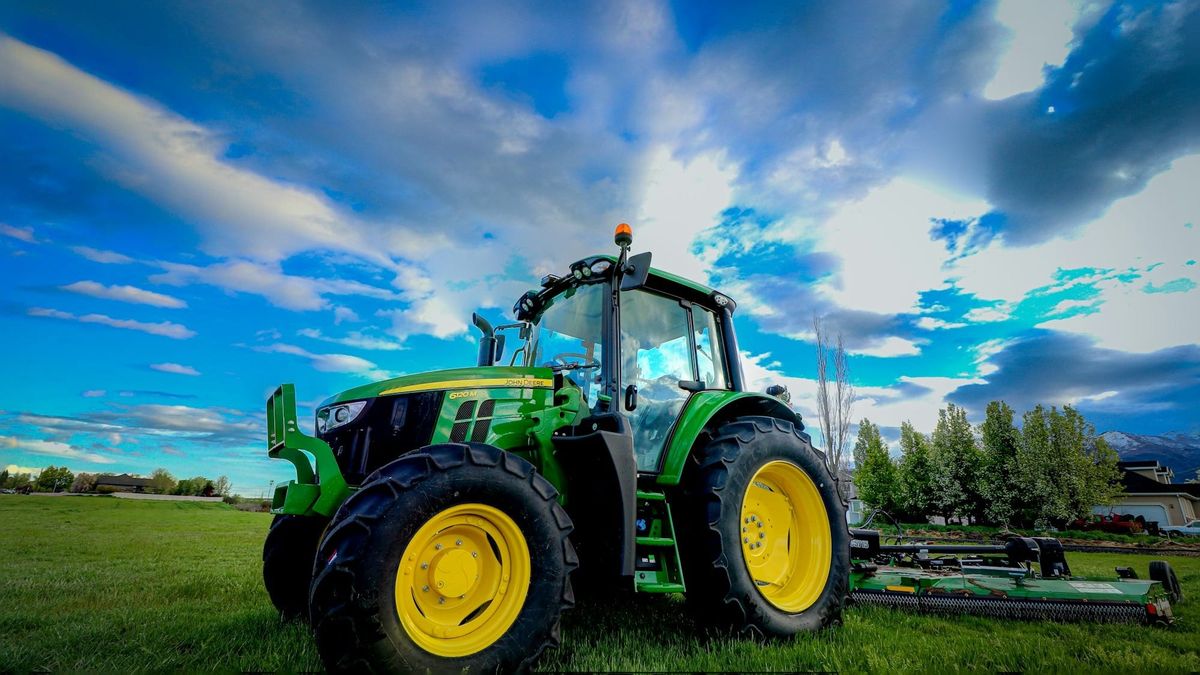
Deere Finds Growth Outside Its Struggling Large-Ag Business
Deere & Company (DE) reported fiscal third-quarter net income of $1.379 billion, or $5.10 per diluted share, compared with $1.289 billion, or $4.75 per share, a year earlier. Total net sales and revenues increased 5% to $12.61 billion, while net sales reached roughly $11 billion.
The stronger quarter came despite another decline in Deere’s largest agricultural equipment segment. Construction and forestry delivered sharply higher sales, profit and margins, while small agriculture and turf also expanded. Deere raised the lower end of its fiscal 2026 net income guidance and reiterated its view that this year should mark the bottom of the current agricultural equipment cycle.
Key Points
- Deere earned $5.10 per diluted share in fiscal Q3 as net income increased to $1.379 billion and total net sales and revenues rose 5% to $12.61 billion.
- Construction and forestry sales jumped 18% and operating profit surged 84%, helping offset a 6% sales decline in production and precision agriculture.
- Deere raised the low end of its fiscal 2026 net income outlook to $4.75 billion and reiterated that 2026 should mark the bottom of the current agricultural equipment cycle.
Construction and Smaller Equipment Drive Deere’s Quarter
The strongest signal from Deere’s third-quarter results came from outside its large agricultural machinery operation.
Construction and forestry net sales increased 18% to $3.62 billion. Operating profit surged 84% to $436 million, while the segment’s operating margin expanded to 12.1% from 7.7% a year earlier.
Small agriculture and turf also delivered growth. Sales increased 12% to $3.38 billion, while operating profit rose 28% to $622 million.
Those businesses helped Deere generate its first year-over-year increase in quarterly net income in roughly three years.
The improvement is significant given the continuing pressure on Deere’s core large-agriculture operation. Farmers have faced lower crop prices and higher costs for inputs such as fertilizer and fuel, reducing their spending power for new machinery.
Deere has responded in part by reducing production and working to normalize equipment inventories.
North American new inventories of high-horsepower tractors and combines have fallen more than 50% from their mid-2024 peaks, while used inventories in those categories have declined by mid-teen percentages.
At the same time, Deere’s technology adoption continued to advance. See & Spray acreage is tracking ahead of last year’s 5 million global acres, while second-year Precision Essentials renewal cohorts are above 90%.
Why Did DE Stock Rally Despite Continued Large-Ag Weakness?
DE stock climbed roughly 8% following the report as earnings exceeded expectations, margins showed strength in key businesses, and management narrowed its full-year profit outlook by raising the lower end of guidance.
Deere reported diluted EPS of $5.10, above estimates cited in the supplied material ranging from roughly $4.67 to $4.79. Net sales of about $11 billion also exceeded forecasts of approximately $10.73 billion to $10.81 billion.
The results cleared expectations even though production and precision agriculture remained under pressure.
Sales in that segment declined 6% to $3.998 billion as reduced shipment volumes continued to weigh on the business. Operating profit fell 9% to $527 million, and operating margin eased to 13.2% from 13.6%.
For fiscal 2026, Deere expects production and precision agriculture sales to decline roughly 10%. By comparison, small agriculture and turf sales are expected to rise 15%, while construction and forestry sales are projected to increase 20%.
That mix illustrates how Deere’s diversified operations are helping offset the agricultural equipment downturn.
The earnings beat also came with important qualifications. Third-quarter results included $110 million of tariff recoveries, bringing year-to-date recoveries to $382 million. The year-earlier quarter also included a $61 million impairment.
Those items mean the improvement in headline earnings was not entirely attributable to recurring operating performance.
Still, the combination of stronger construction results, improved margins and better-than-expected overall earnings provided a positive earnings reaction at a time when investor sentiment toward Deere had been described as skewed negative.
Deere’s Cycle-Bottom Thesis Faces Its Next Test
Management continues to believe fiscal 2026 will mark the bottom of the current agricultural equipment cycle.
CEO John C. May cited early-order program trends, improving used-equipment inventories and increased customer adoption of Deere’s advanced technologies as reasons for confidence.
The industry outlook, however, remains challenging.
Deere expects U.S. and Canadian large agriculture equipment volumes to decline 15% to 20%. Its outlook for South America was reduced to a decline of 15% to 20%, compared with a previous expectation for a roughly 15% decline. The European outlook was lowered to flat from a previous range of flat to 5% growth.
Construction provides a much different backdrop. Deere expects U.S. and Canadian construction equipment volumes to rise 5% to 10%, while global roadbuilding volumes are projected to increase about 10%.
Tariffs remain another factor affecting the earnings picture. Deere faces approximately $1.2 billion of gross direct tariff exposure for fiscal 2026, although recoveries, sourcing changes, exemptions and cost actions reduce the ultimate net effect.
With limited appetite for aggressive price increases in a weak agricultural market, the balance between pricing and costs remains an important part of Deere’s margin performance.
The company’s full-year net income guidance now stands at $4.75 billion to $5 billion, compared with its previous range of $4.5 billion to $5 billion. The new midpoint is $4.875 billion.
That guidance implies fourth-quarter net income of roughly $900 million to $1.2 billion, compared with the approximately $1.1 billion Wall Street projection cited in the supplied material.
What It Means for Investors
Deere’s latest earnings provide evidence that the company can generate stronger results even before its largest agricultural machinery business returns to growth.
Construction and forestry was the clearest example. An 18% increase in sales translated into an 84% increase in operating profit and substantial margin expansion. Small agriculture and turf also contributed double-digit sales growth and a 28% increase in operating profit.
Large agriculture remains the key weakness. Production and precision agriculture sales and profits both declined, and Deere continues to expect large-equipment industry volumes in North America to fall between 15% and 20%.
That makes management’s cycle-bottom assessment particularly important to the DE stock story.
Deere is pointing to lower new and used equipment inventories, early-order trends and greater adoption of its technology as supporting evidence. The company has also maintained earnings through diversification as construction demand offsets some of the agricultural weakness.
At the same time, the quarter included $110 million of tariff recoveries, and the full-year guidance increase was measured rather than broad. The upper end remained unchanged at $5 billion.
The next evidence surrounding Deere’s cycle assessment will therefore come from the same areas management highlighted: large-agriculture orders, continued dealer inventory normalization, construction margins and the performance of its technology offerings.
Conclusion
Deere’s fiscal third quarter delivered a notable change in its earnings trend.
Net income increased year over year for the first time in roughly three years, reaching $1.379 billion. Earnings of $5.10 per share exceeded expectations, while total net sales and revenues increased 5%.
The improvement did not come from a recovery in Deere’s largest agricultural machinery operation. Production and precision agriculture sales fell 6%, and operating profit declined 9%.
Instead, construction and forestry emerged as the quarter’s strongest contributor, with sales rising 18%, operating profit climbing 84%, and margins expanding sharply. Small agriculture and turf provided another source of growth.
Deere’s roughly 8% stock rally reflects that better-than-expected performance alongside a higher floor for full-year profit guidance.
The larger question remains whether management’s view that fiscal 2026 represents the bottom of the agricultural equipment cycle will be confirmed. For now, Deere’s results show that construction, smaller equipment, inventory discipline and technology adoption are helping support the company while the large-agriculture downturn continues.
FAQs
Why did Deere stock rise after its third-quarter earnings?
Deere stock rose roughly 8% after the company reported better-than-expected earnings, strong construction and forestry results, and raised the low end of its fiscal 2026 net income guidance.
How much did Deere earn in the third quarter?
Deere reported third-quarter net income of $1.379 billion, or $5.10 per diluted share, compared with $1.289 billion, or $4.75 per share, a year earlier.
Which Deere business performed best during the quarter?
Construction and forestry delivered particularly strong growth. Net sales increased 18% to $3.62 billion, operating profit rose 84% to $436 million, and operating margin expanded to 12.1% from 7.7%.
Is Deere’s large agriculture business recovering?
Production and precision agriculture remained under pressure in the third quarter, with sales declining 6% and operating profit falling 9%. Deere nevertheless reiterated its view that fiscal 2026 should mark the bottom of the current agricultural equipment cycle.
What is Deere’s fiscal 2026 profit guidance?
Deere expects fiscal 2026 net income of $4.75 billion to $5 billion. The company raised the lower end of the range from its previous forecast of $4.5 billion to $5 billion.
This article was created with AI assistance and reviewed by an editor. For details, please refer to our Terms of Use.
Go Beyond the Market Brief with Market Edge
Follow SharperTrades’ complete approach to trading and investing, combining active trade opportunities through Block Orders, long-term research through Stock Investor, and structured market education through the Swing Trading Masterclass. Try Market Edge for $19 your first month →
Explore Research with Stock Investor
Stock Investor is SharperTrades’ platform for long-term investing research and portfolio management. Members receive research reports, portfolio updates, conviction tracking, and in-depth analysis designed to support disciplined investment decisions.
Explore Active Trading & Income Strategies
Block Orders tracks institutional activity and highlights active trade setups and price behavior across long and short opportunities.
For options-focused traders, Essential Option Income provides a structured approach to options income strategies, while Pro Option Trader offers a broader range of options strategies and trade opportunities.
Think More Clearly with SteadyCapital
SteadyCapital is SharperTrades’ decision-support system for long-term investors, built around the SteadyCapital Method™. Review investment ideas, challenge assumptions, evaluate valuation and risk, compare companies, and think through important buy, hold, add, trim, or sell decisions before you act.
Risk Disclosure
All content is provided for educational purposes only and does not constitute investment advice. Trading involves risk, and past performance is not indicative of future results. Please review our full Risk Disclosure for additional information.