2026 Midterm Elections: Which Stocks Could Benefit or Face Risks?
The November 3 midterm elections could reshape congressional oversight and spending priorities. Here are the stocks and sectors facing potential opportunities and risks under three outcomes.

How the 2026 Midterm Elections Could Reshape Wall Street
The November 3 U.S. midterm elections could reshape Washington's legislative priorities and introduce new risks for industries ranging from artificial intelligence and banking to healthcare, energy and defense. Investors face three broad outcomes: divided congressional control, Democratic control of both chambers, or continued Republican control of Congress.
Yet the election is only part of the market picture. Persistent inflation, elevated Treasury yields, strong AI-related investment and uneven consumer spending could have as much influence on stock performance as the balance of power in Washington.
Key Points
- Congressional control could alter sector-specific risks. Banking, cryptocurrency, AI and healthcare companies may face different levels of legislative scrutiny, while federal spending priorities could affect defense and clean energy.
- A Democratic Congress would not automatically mean major policy changes. Presidential veto power, Senate procedural rules and existing executive authority would limit what lawmakers could accomplish.
- Market fundamentals remain critical. Historical post-midterm returns have been favorable, but inflation, interest rates, earnings and AI infrastructure spending could determine how individual stocks respond.
What Are Markets Watching Ahead of the 2026 Midterms?
The election will determine control of the House of Representatives and Senate for the final two years of President Donald Trump's current term. Prediction markets cited by Briefing.com on October 26 assigned a 93% probability to Democrats gaining the House and 65% to Democrats gaining the Senate. These figures reflect market-implied expectations at a particular moment, not confirmed outcomes.
The stakes extend beyond legislation. Congressional majorities determine committee leadership, oversight priorities, investigative authority and bargaining power during federal budget negotiations. Democrats controlling one or both chambers could increase scrutiny of financial institutions, cryptocurrency businesses, artificial intelligence companies and healthcare providers, while Republicans retaining both chambers could provide greater continuity for the administration's legislative priorities. However, congressional control does not determine policy outcomes on its own. The president retains veto authority, federal agencies continue to exercise their existing powers, and state governments regulate many activities independently.
The Economic Backdrop Complicates the Election Outlook
According to Barron's October 22 economic review, U.S. GDP growth averaged an annualized 2.2% over the preceding six quarters, while September inflation reached 3.7%. The report also highlighted a divergence between strong stock market performance and weakening household sentiment. AI-related capital spending has supported economic activity, but higher energy costs, tariffs and slower real wage growth have placed pressure on consumers.
Treasury yields are another consideration. Higher borrowing costs can weigh on housing demand, utility valuations and capital-intensive projects, regardless of which party controls Congress. Consequently, an election-related improvement in sentiment would not necessarily translate into stronger earnings or higher valuations for every industry.
Which Stocks Could Benefit or Face Pressure Under Each Congressional Scenario?
Scenario A: Democrats Win the House, Republicans Retain the Senate
A divided Congress could limit the passage of major legislation while giving Democrats greater authority to conduct House investigations and challenge administration policies.
Potential areas of exposure
| Sector | Representative stocks | What investors would monitor |
|---|---|---|
| AI and data centers | NVDA, CRWV, NBIS | Congressional hearings, electricity costs and state-level permitting |
| Banking | JPM, BAC | Oversight of deregulation, consumer protection and AI use |
| Cryptocurrency | COIN, HOOD | Investigations and delays to market-structure legislation |
| Electrical infrastructure | ETN, PWR, HUBB | Continued grid investment alongside regulatory uncertainty |
| Defense | RTX, NOC, GD | Spending negotiations and defense appropriations |
AI infrastructure could experience competing pressures. Companies developing and operating data centers would continue to face electricity availability, construction costs and financing requirements, while congressional attention to utility bills could increase pressure on developers to cover more of their power-related expenses. Electrical equipment suppliers such as Eaton (ETN), Hubbell (HUBB) and Quanta Services (PWR) have exposure to grid modernization and infrastructure investment, but their prospects would depend on actual customer spending and project activity, not simply the election outcome. Banks and cryptocurrency businesses could face more investigations without necessarily encountering immediate changes in federal regulation.
Scenario B: Democrats Win Both the House and Senate
Democratic control of both chambers would increase the party's ability to advance legislation, set committee agendas and influence federal spending negotiations. Nevertheless, President Trump could veto legislation, and major proposals could still encounter Senate procedural obstacles.
| Sector | Representative stocks | Potential implications |
|---|---|---|
| Hospitals | HCA, THC, UHS | Efforts to preserve Medicaid funding and ACA-related coverage |
| Health insurers | UNH, CVS, HUM | Greater scrutiny of insurance practices, costs and coverage decisions |
| Clean energy | FSLR, ENPH, NEE | Potential legislative support, subject to political and fiscal constraints |
| Defense | LMT, NOC, LHX | Greater uncertainty around selected defense spending priorities |
| Energy infrastructure | WMB, ET | Changes to negotiations over federal permitting legislation |
| Crypto | COIN, HOOD, CRCL | Increased oversight and potentially slower regulatory legislation |
Healthcare is one of the clearest examples of differing effects within the same sector. Efforts to preserve Medicaid coverage or Affordable Care Act subsidies could support patient access and hospital reimbursement, and HCA Healthcare (HCA), Tenet Healthcare (THC) and Universal Health Services (UHS) are among the hospital operators investors may examine. Health insurers, however, could face additional scrutiny involving claim denials, insurance costs and reimbursement practices. That does not establish a uniformly negative outcome for insurers, since coverage and funding changes could also affect enrollment and revenue.
Energy policy would present similar complications. Clean energy companies could benefit from proposals supporting renewable power, but new federal funding would face legislative and presidential constraints. Meanwhile, the future of energy-permitting reform could affect natural gas infrastructure companies such as Williams (WMB) and Energy Transfer (ET).
Scenario C: Republicans Retain Both Chambers
Continued Republican control could preserve a more favorable legislative environment for the administration's existing priorities, including financial deregulation, conventional energy development and cryptocurrency market legislation.
| Sector | Representative stocks | Potential implications |
|---|---|---|
| Banking | JPM, GS, MS | Greater continuity in regulatory and legislative priorities |
| Energy | XOM, COP, WMB | Potential support for conventional energy and permitting |
| Cryptocurrency | COIN, HOOD | Greater opportunity to advance industry-backed legislation |
| Defense | RTX, LMT, GD | Potential support for defense funding proposals |
| AI infrastructure | NVDA, MSFT, ETN | Policy continuity, alongside power and capital-spending constraints |
Policy continuity would not eliminate risks. Financial institutions would still face credit conditions, loan demand and interest-rate changes, while energy companies would remain sensitive to commodity prices and global supply. AI-related businesses would continue to confront electricity availability, financing costs and the economics of large-scale capital investment. The same distinction applies to defense contractors: political support for military spending does not guarantee that every program receives additional funding.
Risks That Cross All Three Scenarios
Some issues do not fit neatly into a partisan framework. Data-center electricity costs have attracted bipartisan attention, while state-level regulation could affect projects independently of congressional control. Housing affordability, tariffs and federal borrowing requirements also remain relevant under every outcome.
Tariff policy deserves particular attention because Congress and the executive branch possess different authorities. Legislative opposition to tariffs would not necessarily result in their removal, particularly where a presidential veto or existing executive powers are involved. For investors, the central question is not merely which party controls Congress, but whether a political development changes a company's operating costs, revenue opportunities, regulatory exposure or earnings outlook.
Does History Favor Stocks After Midterm Elections?
Historical market performance provides another perspective on the election, although it offers no guarantee of future returns. According to an October 27 Benzinga analysis using TradingView data, the S&P 500 recorded positive price returns in all 19 twelve-month periods beginning at the end of October in midterm election years since 1950.
19 of 19
Positive 12-month periods
16.6%
Average 12-month gain
13 of 19
Positive October–December periods
Source: Benzinga, October 27, 2026, citing TradingView historical S&P 500 price data. Returns exclude dividends.
The distinction between long-term and immediate performance is important.
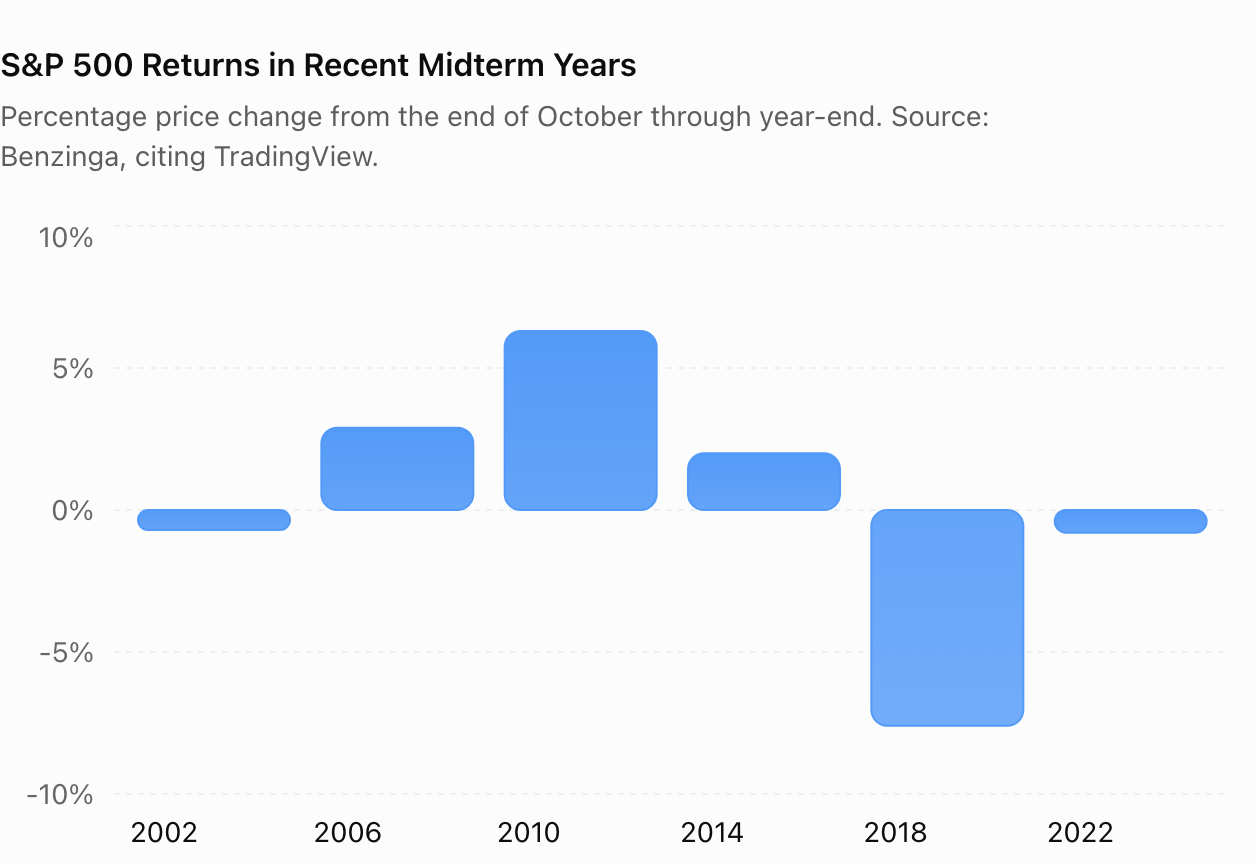
In 2018, for example, the S&P 500 declined 7.6% between the end of October and year-end, despite subsequently recording a positive return over the full twelve-month measurement period. The Motley Fool also cited JPMorgan research describing historically favorable post-midterm returns, partly associated with reduced political uncertainty.
However, these observations have important limitations. The historical sample is small, economic conditions differ considerably across election cycles, and the measurements do not establish that elections themselves caused the subsequent market gains. Historical seasonality may provide context, but it cannot determine the direction of stocks in November or over the following year.
What It Means for Investors
The 2026 midterm elections introduce several potential sources of market uncertainty, but their effects are unlikely to be uniform across sectors. Three distinctions are particularly important.
First, congressional oversight is not the same as legislation. Hearings and investigations can create uncertainty for individual companies without producing immediate changes in the law, which is especially relevant to banking, cryptocurrency, healthcare and artificial intelligence.
Second, sector exposure does not guarantee a favorable stock reaction. Increased grid investment could support electrical infrastructure demand, but project costs, financing conditions and valuations remain important. Healthcare funding proposals could benefit hospitals while producing a more complicated outlook for insurers.
Third, economic fundamentals may outweigh political developments. Corporate earnings, Treasury yields, inflation and consumer spending will continue to influence valuations regardless of the congressional outcome.
For portfolios with substantial exposure to AI and technology, the interaction between data-center spending, electricity availability and regulatory scrutiny deserves attention. Investors exposed to healthcare, financials, defense and energy face different combinations of legislative, operational and economic risks. The election may clarify the direction of congressional oversight and policy negotiations, but it will not resolve every uncertainty affecting the stock market.
Conclusion
The November 3 midterm elections could reshape the policy environment for several major industries, with different implications under divided congressional control, a Democratic Congress or continued Republican leadership. AI infrastructure, healthcare, banking, cryptocurrency, energy and defense are among the sectors with identifiable policy exposure. Yet presidential veto power, existing regulatory authority and state-level decisions will limit or complicate the effects of congressional changes.
Historical market performance following midterms has generally been favorable, but near-term returns have been less consistent. Ultimately, the most meaningful developments for individual stocks will be those that affect earnings, financing costs, investment spending and business conditions—not simply the election results themselves.
Frequently Asked Questions
How could the 2026 midterm elections affect the stock market?
The elections could change congressional oversight, spending priorities and the prospects for new legislation. Their effects would vary across industries, while inflation, interest rates and corporate earnings would remain important market drivers.
Which stocks could be affected by Democratic control of Congress?
Companies in AI, banking, cryptocurrency, healthcare, energy and defense could face changes in legislative attention or spending priorities. Examples include NVDA, JPM, COIN, HCA, WMB and LMT, although the effects would depend on specific policy developments.
Could healthcare stocks benefit from a Democratic Congress?
Hospitals could benefit from efforts to preserve Medicaid funding or Affordable Care Act coverage. Health insurers could face greater scrutiny of pricing and coverage practices. The effects would vary by business model and any policies ultimately adopted.
Does the stock market usually rise after midterm elections?
Historical S&P 500 data show generally favorable twelve-month returns following midterm years, but shorter-term performance has been less consistent. Historical patterns do not guarantee future results.
Could AI stocks face additional regulation after the election?
AI companies and data-center developers could face greater congressional scrutiny concerning safety, electricity costs and infrastructure development. State-level permitting and regulation could also affect projects independently of congressional control.
Sources & Further Reading
Barron's — What a Democratic Congress Would Mean for Wall Street
Barron's — The Trump Economy in 7 Charts
Briefing.com — 2026 Midterm Preview
Benzinga — This Midterm's Stock-Market Pattern Hasn't Failed Since 1950
This article was created with AI assistance and reviewed by an editor. For details, please refer to our Terms of Use.
Go Beyond the Market Brief with Market Edge
Follow SharperTrades’ complete approach to trading and investing, combining active trade opportunities through Block Orders, long-term research through Stock Investor, and structured market education through the Swing Trading Masterclass. Try Market Edge for $19 your first month →
Explore Research with Stock Investor
Stock Investor is SharperTrades’ platform for long-term investing research and portfolio management. Members receive research reports, portfolio updates, conviction tracking, and in-depth analysis designed to support disciplined investment decisions.
Explore Active Trading & Income Strategies
Block Orders tracks institutional activity and highlights active trade setups and price behavior across long and short opportunities.
For options-focused traders, Essential Option Income provides a structured approach to options income strategies, while Pro Option Trader offers a broader range of options strategies and trade opportunities.
Think More Clearly with SteadyCapital
SteadyCapital is SharperTrades’ decision-support system for long-term investors, built around the SteadyCapital Method™. Review investment ideas, challenge assumptions, evaluate valuation and risk, compare companies, and think through important buy, hold, add, trim, or sell decisions before you act.
Risk Disclosure
All content is provided for educational purposes only and does not constitute investment advice. Trading involves risk, and past performance is not indicative of future results. Please review our full Risk Disclosure for additional information.